Most email platforms grow the same way: one new dashboard, one new setting, one new toggle at a time. Customers end up with a longer feature list but not necessarily a better sense of where the platform is actually headed.
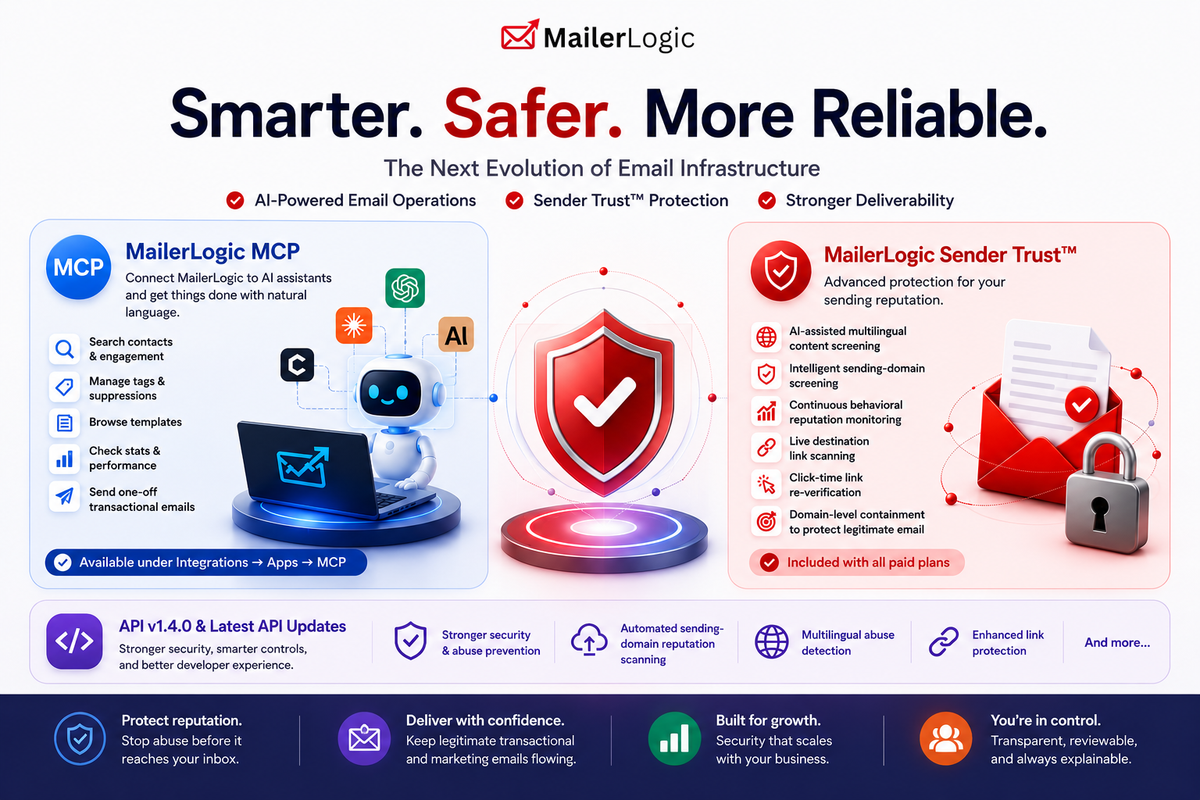
MailerLogic MCP, MailerLogic Sender Trust™, and a significant reliability and deliverability upgrade rolled out across the platform this quarter aren't three unrelated features. They're three parts of the same idea: your email infrastructure should be easier to operate, harder to compromise, and more dependable as you scale.
Here's what that Looks Like in Practice
AI-powered email operations
With MailerLogic MCP, control MailerLogic directly from the AI tools you already use.
Proactive reputation protection
MailerLogic Sender Trust™ helps catch abuse earlier and contain it precisely, without punishing legitimate senders.
A stronger delivery foundation
More accurate analytics, more resilient bounce processing, and infrastructure designed to keep transactional email moving regardless of what else is happening on the platform.
Each is worth knowing about individually. Together, they represent where MailerLogic is going: smarter to operate, safer to send through, and more reliable as you grow.
Smarter to Operate: Email Meets AI with MailerLogic MCP
If you've ever had to open three different dashboard screens just to check whether a campaign performed well, you already know the friction MCP is designed to remove.
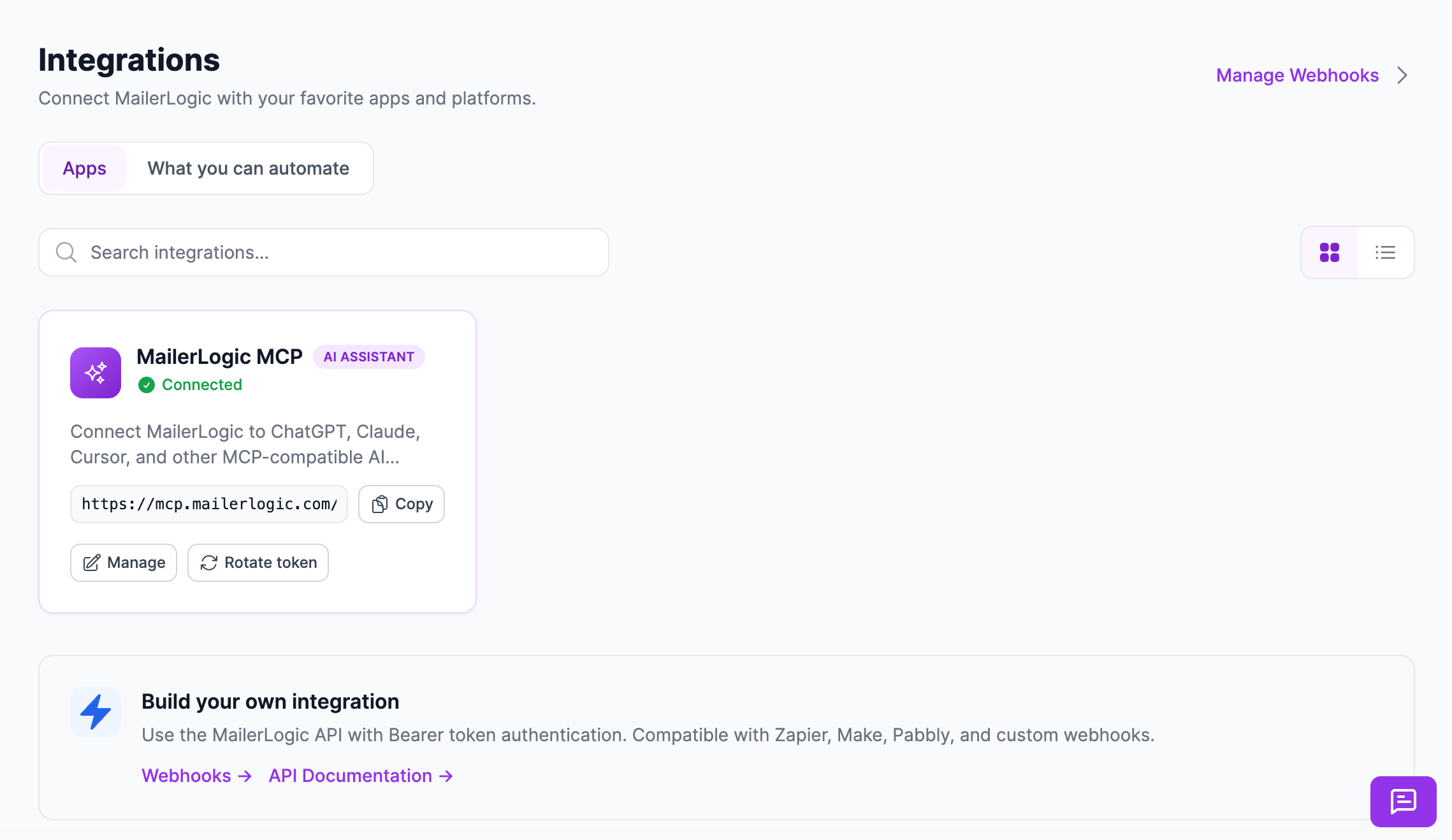
MailerLogic MCP connects your MailerLogic account directly to MCP-compatible AI assistants and development tools, including ChatGPT, Claude, Cursor, Claude Code, and many more. Instead of clicking through menus to perform routine tasks, you can now just ask.
That might look like:
- "Show me contacts who engaged with my latest campaign."
- "Check my recent sending performance."
- "Suppress this contact."
- "Find the template I used for our welcome email."
Under the hood, MCP gives your AI assistant access to real MailerLogic capabilities, searching contacts and engagement history, managing tags and suppressions, browsing templates, checking sending statistics, and sending one-off transactional emails, all through natural language instead of a UI or a raw API call.
To be clear about what this is and isn't: MCP doesn't replace the MailerLogic dashboard or the API. It's a third way in, purpose-built for the growing number of workflows that now start inside an AI assistant rather than a browser tab. If your team already lives in Claude or ChatGPT for half the workday, MailerLogic can now meet you there instead of pulling you back out.
💡 MailerLogic MCP is available under Integrations → Apps → MailerLogic MCP, and is included with all paid plans.
Safer to Send: Introducing MailerLogic Sender Trust™
Deliverability and security aren't really two separate problems; they're the same problem viewed from different angles. A compromised sending domain, a phishing link slipped into a campaign, or a sudden unexplained spike in send volume doesn't just put recipients at risk. It puts your sender reputation at risk, and reputation is the thing every other deliverability effort depends on.
MailerLogic Sender Trust™ is a new security framework built to catch those risks earlier and respond to them more precisely than a traditional spam filter would. It combines a few different layers of protection working together:
- AI-assisted phishing and fraud detection that works across multiple languages, not just English
- Intelligent screening of sending domains before problems start
- Continuous, behavioral reputation monitoring rather than one-time checks
- Live scanning of destination links, plus re-verification at the moment someone actually clicks
That last point matters more than it might sound. A link can look completely safe when an email is sent and then turn malicious hours or days later, once it's already sitting in thousands of inboxes. Most security scans only happen once, at send time. Sender Trust re-verifies links at click time too, so a destination that changed after delivery doesn't get a free pass just because it passed inspection originally.
The most important design decision behind Sender Trust, though, is how it responds when something does look wrong. The principle is simple: protect the problem, keep legitimate email moving. When suspicious activity is isolated to one sending domain, Sender Trust is built to act against that domain specifically rather than treating the entire account as compromised. For any organization running multiple sending domains or subdomains, one for product updates, another for billing receipts, another for a specific customer program, that distinction is the difference between a contained incident and a platform-wide outage of your own making.
Sender Trust isn't meant to be a black box, either. The goal throughout is transparency: detect abuse earlier, protect the shared infrastructure every MailerLogic customer relies on, reduce reputation damage when something does go wrong, and keep legitimate transactional and marketing email flowing whenever it's safe to do so.
This kind of precision doesn't happen at the application layer alone; it required real work on the API and security infrastructure underneath, including automated sending-domain reputation scanning, multilingual abuse detection, and stronger link protection shipped as part of API v1.3.0 earlier this year. Think of that release as the plumbing Sender Trust runs on, rather than a separate feature in its own right.
Sender Trust is included with all paid plans and is active now.
More Reliable Underneath
New intelligence and new security controls only matter if the infrastructure underneath them holds up under real sending volume. That's what our August 2026 reliability and deliverability release was built to address: a set of improvements to analytics, bounce processing, message routing, retries, and the API that most customers will never think about directly, but will feel the absence of problems from.
More accurate analytics. Delivered, bounced, and failed outcomes are now recorded so that internal retries and duplicate delivery events don't inflate your daily or monthly totals. We've also improved how MailerLogic handles late, asynchronous bounces. If a receiving server initially accepts a message and only reports a bounce later, MailerLogic now revises that message's outcome and attributes it back to the original send date, instead of leaving your numbers wrong. If your reported totals look slightly lower after this change, that's not a regression; it means duplicate retry events have been removed and you're now looking at unique message outcomes.
Stronger transactional email isolation. Password resets, verification emails, receipts, and account notifications now travel through separate queues and IP routing infrastructure from broadcast campaigns. A large newsletter send should never be able to slow down a password-reset email; that separation is now built into the routing layer itself, not left to chance.
Smarter message stream classification. MailerLogic can now recognize when traffic declared "transactional" is actually behaving like a bulk broadcast, and route it accordingly instead of holding it unnecessarily for manual review. If you're integrating via the API, the /send endpoint now tells you which stream your message actually took, and whether it was reclassified, so you're never guessing.
More resilient bounce processing. Bounce handling now recovers more reliably from interruptions, and duplicate bounce reports are detected and merged automatically, which means cleaner suppressions, more accurate campaign metrics, and webhook events you can actually trust.
Fewer false positives. We've tightened up how security review distinguishes real threats from legitimate email, including more consistent whitelist handling, better support for sender addresses that include display names, improved handling of internationalized domains, and better support for non-English content. Security reviews now look for corroborating signals before holding a legitimate message, instead of acting on a single flag.
Faster retries. Messages temporarily deferred by a receiving mail server can now skip re-running security checks that have already completed, getting them back into the delivery pipeline faster.
Rotation-safe links. Tracking and unsubscribe links now stay valid across MailerLogic's security-key rotations, so we can follow stronger credential-rotation practices on our end without ever breaking a link you sent last month.
For most customers, none of this requires any action. If you're a developer working directly against the API, the accompanying OpenAPI 1.4.0 update documents all of it: new /send response fields, transactional and broadcast stream defaults, stable webhook event_id values for deduplication, and clearer retryable 503 behavior. Worth a read if you're building anything that depends on precise delivery status.

Bringing It Together
Strip away the feature names and three ideas are doing all the work here:
Smarter to operate
MailerLogic MCP brings everyday email operations into the AI assistants and AI-powered development environments where a growing share of work already happens.
Safer to send
MailerLogic Sender Trust™ adds intelligent, precisely targeted safeguards that catch abuse early and contain it without punishing the rest of your sending.
More reliable underneath
Infrastructure improvements shipped this year strengthen everything from analytics accuracy and transactional isolation to retry behavior, giving the first two ideas a solid foundation.
None of this is about giving you more ways to send email. It's about building intelligence, security, and reliability into the entire lifecycle of a message, from how you interact with MailerLogic in the first place, to how each message gets evaluated, routed, delivered, measured, and protected along the way.
Built for What's Next
Sending a message and hoping it arrives was never really the bar. Modern email infrastructure has to give you accurate data, dependable transactional delivery, real protection against reputation-damaging abuse, an API you can actually build on, and, increasingly, a way to fold email operations into the AI-powered workflows your team already uses every day.
That's the direction we're building MailerLogic toward.
MailerLogic MCP, MailerLogic Sender Trust™, and the latest reliability and deliverability improvements are all live now. We'd genuinely like to hear what you think as you try them.