
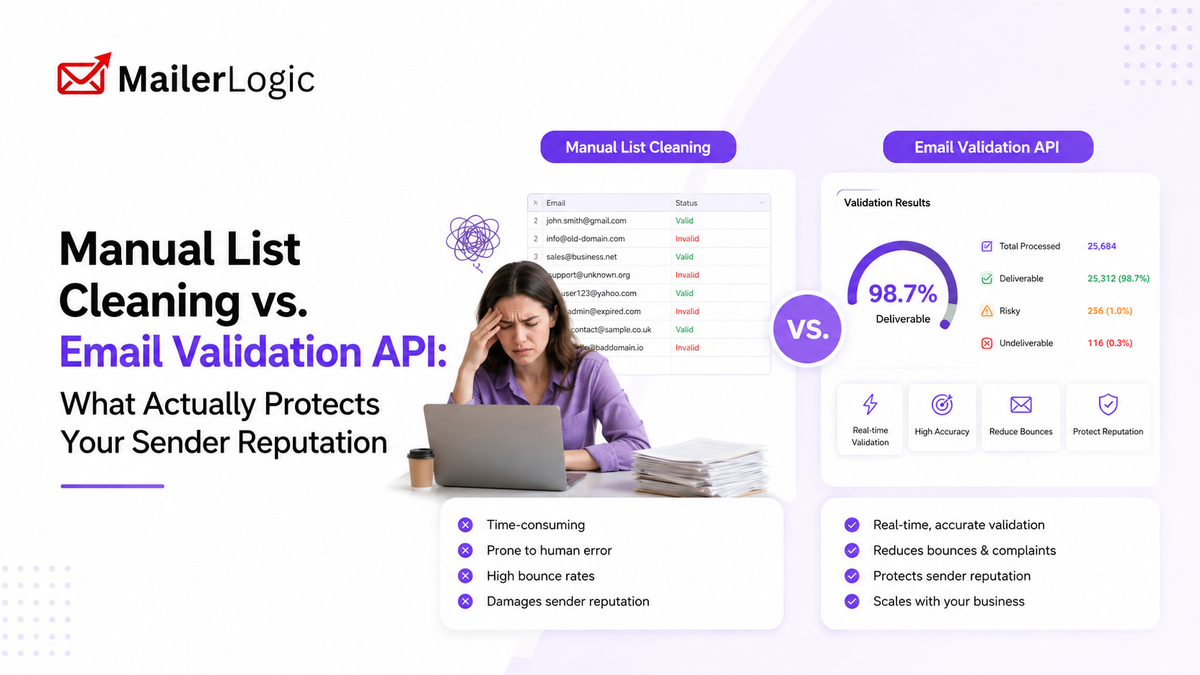
If you've been sending email for any length of time, you've stared at a bounce report and felt that quiet dread. A 4% bounce rate last month. A 6% rate this month. Inbox placement slipping. A handful of spam complaints you can't trace back to a campaign.
Most of those problems trace back to a single root cause: junk addresses sitting in your list.
The fix sounds simple: clean the list. But how you clean it matters far more than most marketers realize. Manual list cleaning and email validation APIs solve the same problem on paper. In practice, they operate at completely different speeds, costs, and levels of reliability.
What Manual List Cleaning Actually Looks Like
Manual list cleaning is the original method. It's still common, especially among teams that don't trust automation or don't know better alternatives exist. The workflow usually looks like this:
- Export your list from your ESP as a CSV
- Open it in Excel or Google Sheets
- Look for obvious typos (gmial.com, yaho.com, hotnail.com)
- Check role-based addresses (info@, support@, admin@)
- Search for known spam traps and disposable domains from a public list
- Cross-reference against your last few bounce reports
- Manually delete the rows you flagged
- Re-import the cleaned file
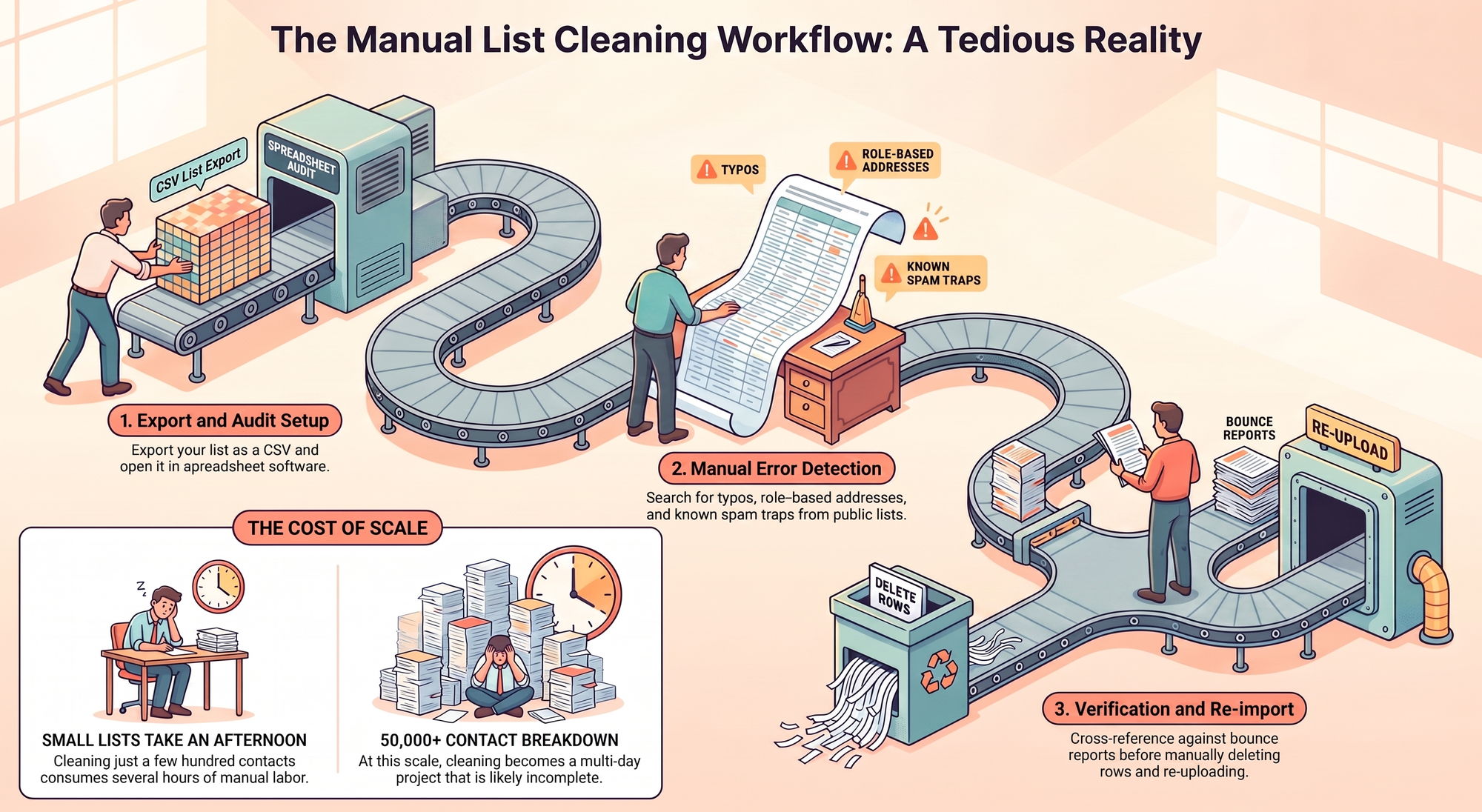
If you have a few hundred contacts, this takes an afternoon. If you have 50,000, it's a multi-day project, and it's almost certainly incomplete.
Where Manual Cleaning Falls Apart
The biggest problem isn't effort. It's accuracy and freshness.
- A typo like
jdoe@gnail.conlooks plausible - A real address like
press@yourcompany.comlooks legitimate - A recently created spam trap looks identical to a valid inbox
You're also working with stale data the moment you finish. Someone unsubscribed yesterday. Someone's mailbox filled up an hour ago. A domain went offline overnight. By the time you re-import your "cleaned" list, a chunk of it is already dirty again.
And then there's the human factor. The person doing the cleaning gets tired. They skip rows. They delete the wrong column. They forget to remove duplicates and accidentally scrub half their engaged subscribers.
Manual cleaning isn't wrong. It's just incomplete by design.
What an Email Validation API Actually Does
An email validation API is a programmatic service you call, usually via an HTTP request, to verify whether an email address is deliverable. Most APIs combine several checks:
| Check | What It Catches |
|---|---|
| Syntax validation | Does the address follow RFC 5322 formatting rules? |
| MX record lookup | Is the domain actually configured to receive email? |
| SMTP handshake | Does the mailbox exist on the receiving server? |
| Disposable domain detection | Is the address from a temporary mail service? |
| Role-based detection | Is it info@, support@, or another catch-all? |
| Typo suggestion | Did someone mean gmail.com instead of gmial.com? |
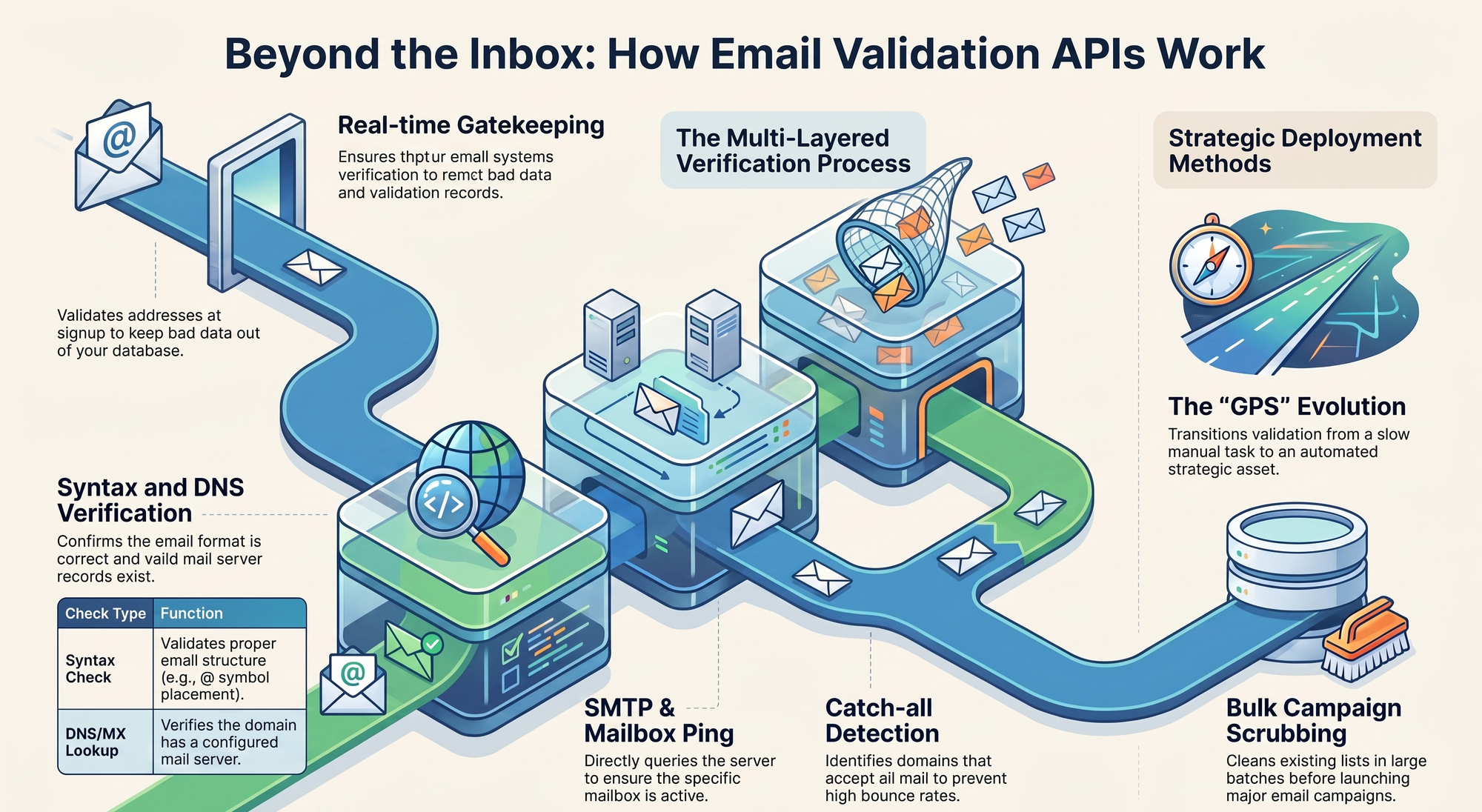
You can call these APIs in real time at the moment of signup (so bad addresses never enter your list) or in bulk before a campaign.
The shift from manual to API-based validation isn't a small upgrade. It's a category change, the way moving from a paper map to GPS didn't just make navigation faster, it made a different set of journeys possible.
Side-by-Side: What Actually Changes
| Factor | Manual List Cleaning | Email Validation API |
|---|---|---|
| Time per 10,000 contacts | 4–8 hours | Seconds to minutes |
| Detection of syntax typos | Partial (human error) | Complete |
| Real SMTP mailbox check | No | Yes |
| Disposable domain detection | Limited | Comprehensive |
| Real-time signup validation | Not feasible | Built-in |
| Cost per verification | Time + labor | Fractions of a cent per address |
| Consistency across runs | Variable | Identical |
| Catches new spam traps | Rarely | Yes (updated databases) |
| Scalable above 50k contacts | Very painful | Trivial |
When you line them up, the comparison gets uncomfortable for the manual approach fast.
The Real Cost Nobody Calculates
Here's the part that doesn't show up on a pricing page: sender reputation is built over months and destroyed in days.
Every hard bounce tells mailbox providers your list hygiene is sloppy. Every soft bounce that lingers drags down your deliverability scores. Hit a 5% bounce rate on a list of 10,000 sends, and you've racked up 500 bounces, enough to start losing inbox placement with most major providers.
Recovering from a damaged sender reputation typically takes 4–8 weeks of careful, deliberate sending. Sometimes longer.
Manual cleaning might catch the worst offenders, but it rarely catches enough to keep you under the threshold once you factor in addresses that went bad after your last cleaning pass. An API running at signup and on a scheduled bulk pass catches most of them before they ever reach a mailbox.
How MailerLogic Handles Bounces Behind the Scenes
Even with the best validation upstream, bounces will happen. Mailboxes fill up. Domains expire. People abandon addresses. The question isn't whether bounces occur; it's how fast your system identifies and removes them.
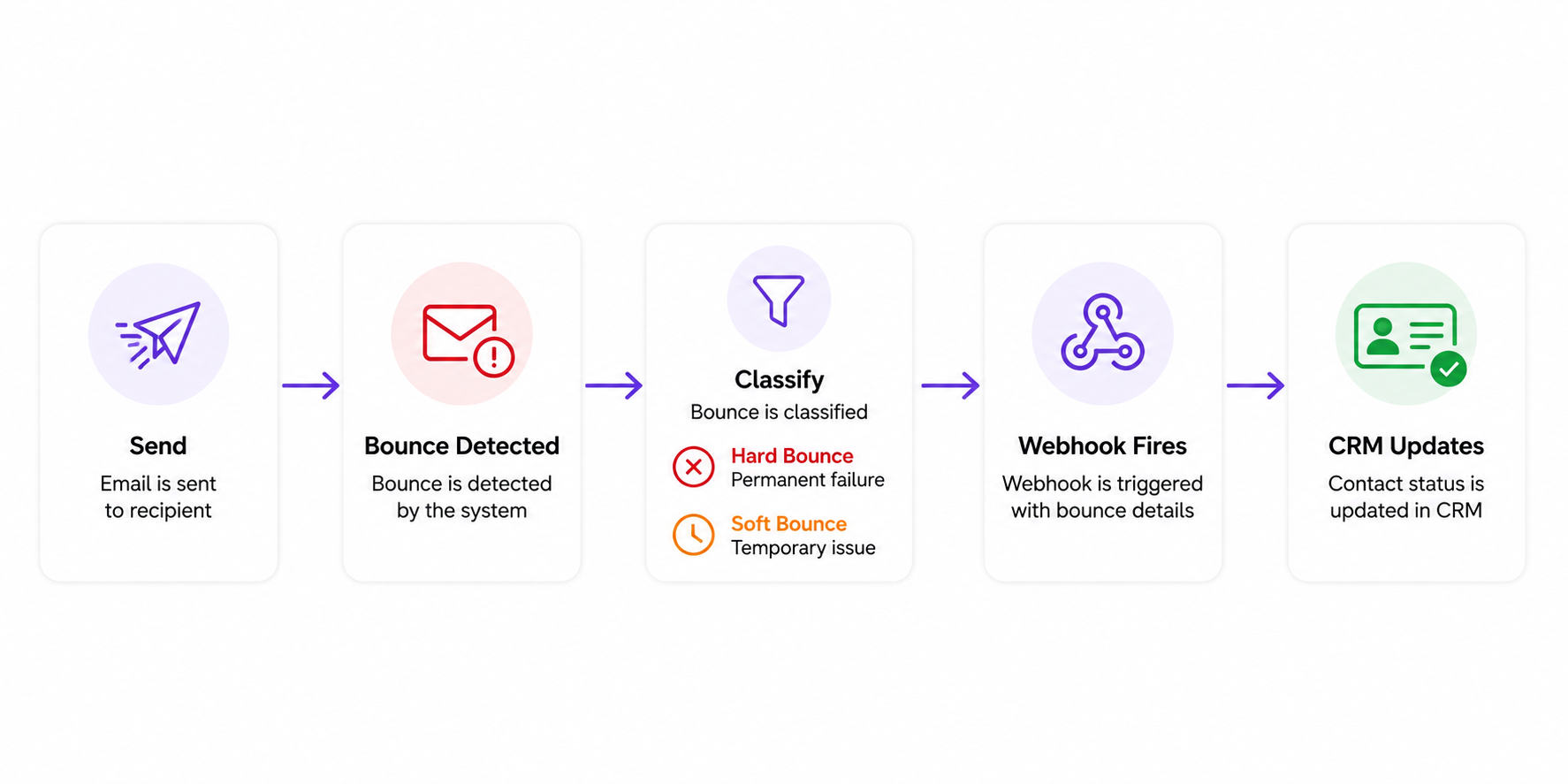
When a hard bounce happens: MailerLogic logs the event, suppresses the recipient immediately, and fires a email.bounced webhook with the bounce type and reason. Pipe that webhook into your CRM or data warehouse, and your downstream systems stay in sync without anyone touching a spreadsheet.
When a soft bounce happens: the system is more patient, allowing several consecutive soft bounces before suppression, so a temporary "mailbox full" issue doesn't cost you a subscriber. Aggressive suppression is just as dangerous as no suppression at all; it shrinks your active list based on transient conditions that often resolve on their own.
MailerLogic also supports a custom bounce domain, which keeps your branding consistent and removes the "via" label some inbox providers add when a third party handles bounces on your behalf. That doesn't directly affect hygiene, but it does affect how recipients perceive your emails, and engaged recipients complain less, which keeps your reputation tighter.
The Honest Answer: When Manual Still Makes Sense
API validation isn't a silver bullet, and pretending otherwise would be dishonest. There are real cases where manual review earns its keep:
| Scenario | Why Manual Helps |
|---|---|
| Highly targeted B2B lists (200–500 contacts) | Each address represents a relationship, a human can verify context an API can't see, like whether the person still works there |
| Re-engagement campaigns | Deciding which "almost-churned" subscribers deserve a manual outreach attempt |
| Compliance reviews (GDPR and similar) | An API can verify the address; only a human can verify the consent trail |
In these cases, manual review supplements the API. It doesn't replace it.
The Practical Setup Most Teams Should Use
If you're starting from scratch or auditing an existing program, here's a workflow that actually holds up:
- Validate at signup. Call the validation API the moment a form is submitted, reject syntax errors, disposable domains, and obvious typos before they ever hit your list.
- Bulk-validate on import. When you upload a CSV, run every address through the API first. Flag
invalid,risky, andaccept-allseparately; don't just delete everything risky. - Listen to webhooks. Connect MailerLogic's
email.bouncedwebhook to your CRM. When a bounce occurs, suppression should propagate to every system holding that contact, not just the email tool. - Re-validate dormant contacts. Anyone who hasn't opened or clicked in 6–12 months should get re-validated before a re-engagement attempt.
- Use automations for follow-through. A simple automation can move newly bounced contacts to a suppression list, tag them for review, or trigger manual outreach to recover the address where appropriate.
This combination catches the vast majority of bad data without requiring someone to spend their Tuesday squinting at Excel.

Ready to stop manually cleaning your list?
Start Free — No Credit CardThe Bottom Line
Manual list cleaning isn't the villain. For tiny lists, it works fine. For larger programs, it's a tourniquet; it slows the bleeding, but it doesn't stop it.
An email validation API gives you real-time detection, consistent accuracy, and a price point that makes scale irrelevant. Pair it with MailerLogic's bounce handling, custom bounce domain, and webhook infrastructure, and you've got a closed loop: validation prevents bad data from entering, automations keep it clean while it's there, and webhooks make sure every system in your stack knows the moment something changes.
Sender reputation is not built by a single tool. It's built by a system. Build the system.